
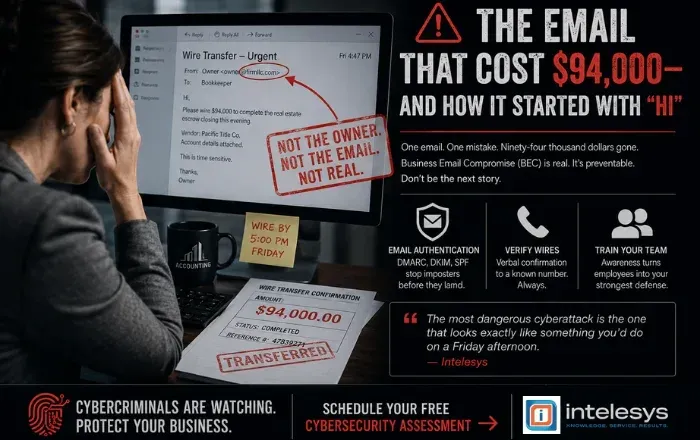
The Email That Cost $94,000 — And How It Started With "Hi"
If you ever want to rob a company, don't bother with the server room. Don't bother with a crowbar or a ski mask. All you need — all you really need — is a well-crafted email and a little patience. The criminals who understand this are, at this very moment, sending emails to businesses just like yours.
Let me tell you about one that landed on a Friday afternoon.
The Rest of the Story
There is an accounting firm in the San Gabriel Valley. Twelve employees. Respectable clientele. An owner who built the business from scratch over seventeen years. She trusted her team. She had reason to.
On a Friday at 4:47 PM, her bookkeeper received an email from the owner's address. The subject line read: Wire Transfer — Urgent. The body was short. Professional. It referenced a real vendor by name — one they had paid before. It asked for a wire of $94,000 to complete a real estate escrow that was closing that evening.
It was not from the owner.
The owner was at her daughter's softball game, phone in her pocket, not checking email. The bookkeeper, not wanting to bother her on a Friday evening and trusting the instruction, processed the wire.
The money was in a foreign account within twenty minutes. It has not been recovered.
The email had come from a domain one letter off from the owner's real one. A lowercase "L" where an "I" should have been. Invisible at a glance. The sender had been watching the firm's email patterns for three weeks before striking — learning the names, the vendors, the tone.
"The most dangerous cyberattack is the one that looks exactly like something you'd do on a Friday afternoon." — Intelesys
What Should Have Stopped It
This attack had a name: Business Email Compromise (BEC). It is the single most financially damaging form of cybercrime in the United States — not ransomware, not data breaches. Plain, patient, human-targeted fraud.
And it is almost entirely preventable.
Email Authentication Protocols — specifically DMARC, DKIM, and SPF — are the technical layer that tells the world which emails are actually from your domain and flags impersonators. Properly configured, they would have flagged that lookalike domain before it ever reached the bookkeeper's inbox.
Beyond the technology, wire transfer verification protocols are a simple, non-negotiable human control: any outbound wire over a set threshold requires a verbal confirmation to a known number. Not a reply email. A phone call.
At Intelesys, we implement both — because one without the other is a door with a lock and an open window.
"Technology can close the digital door. But it takes a culture — a trained, skeptical, empowered team — to keep it closed." — Intelesys
The 4:47 PM Problem
Attackers are not random. They study your habits. They send on Friday afternoons when decision-makers are distracted and staff are eager to wrap up their week. They reference real projects, real vendors, real contexts they've harvested from your public website, your LinkedIn, your previous email threads.
This is called Social Engineering — and it works on smart, careful people every single day.
The accounting firm owner did nothing wrong. Her bookkeeper did nothing wrong. But their firm had no technical safeguards and no verified transfer protocol. In the world of modern cybercrime, that gap was an open invitation.
Your Next Step
One training session isn't enough. One firewall isn't enough. What you need is a complete cybersecurity posture — one that covers your email authentication, your team's awareness, and your internal controls.
Intelesys offers a comprehensive Cybersecurity Assessment that identifies exactly where your firm is exposed. Don't find out the hard way. Find out now. Schedule Your Free Cybersecurity Assessment →
Some lessons cost $94,000. This one's free.